
Handcrafted decorative lighting since 1980 · Worldwide project support
Choosing Handcrafted Chandeliers for Your Project means choosing more than a decorative ceiling fixture. It means selecting a focal point shaped by human skill, material knowledge, and careful attention. Unlike mass-produced lighting, each piece may reveal subtle variations in glass, metal, wood, or crystal. Those details create character. They also make the room feel less predictable.
Lighting designer Ingo Maurer said, “The most important thing about light is that it creates atmosphere.” His observation explains why Handcrafted Chandeliers deserve serious consideration in residential, hospitality, and commercial interiors. A well-designed chandelier can soften a stone dining room, draw attention to a double-height entrance, or add warmth above a polished reception desk. Its scale, color temperature, suspension height, and light distribution must work together. Beauty alone is not enough.
The practical value becomes visible during installation. Skilled makers can often adjust finishes, dimensions, canopy details, and bulb arrangements for a specific space. That flexibility helps designers respond to unusual ceilings or demanding visual concepts. Still, handcrafted does not automatically mean perfect. A small asymmetry may appear. A finish may age differently than expected. These imperfections require honest discussion, not romantic excuses. Buyers should review material samples, maintenance requirements, electrical specifications, and the maker’s previous projects. They should also ask who will install and service the fixture.
This article explores why Handcrafted Chandeliers can strengthen a project’s identity, atmosphere, and long-term value. It also considers when their higher cost is justified—and when it may not be.
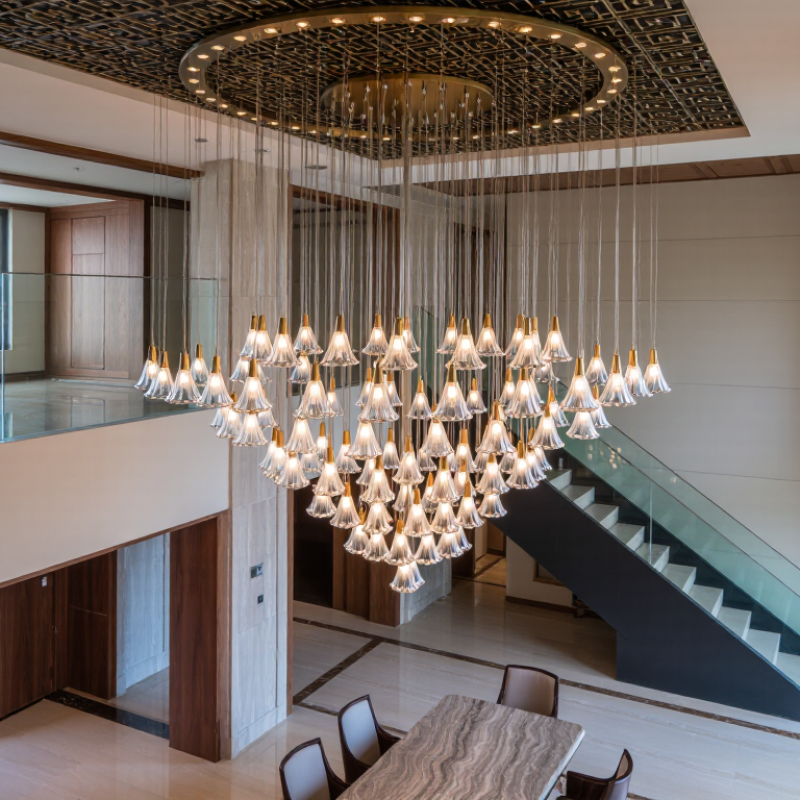
A handcrafted chandelier is defined by human decisions, not merely a rustic appearance. Designers select materials, shape components, and adjust proportions during production. Each arm, shade, or glass element receives individual attention. In a workshop, the maker may refine a joint after seeing how light crosses the frame. That small adjustment can change the room’s atmosphere. Real craftsmanship leaves evidence. Subtle variations in texture, tone, and alignment often show that the piece was not produced from one repeated mold. Yet irregularity alone is not proof of quality. A crooked fitting can be a flaw, not a feature.
For a project, I look for clear construction details. Are the connections secure? Can the ceiling support the finished weight? Are the electrical parts tested and suitable for the installation location? A responsible maker should provide dimensions, material information, care guidance, and installation requirements. These details make the chandelier dependable beyond its first impressive photograph. Hand finishing also supports thoughtful customization. A workshop may alter the drop length, metal tone, shade size, or number of light points for a specific ceiling. However, custom work needs careful drawings. Small misunderstandings become expensive when the fixture is already assembled.
The strongest handcrafted pieces balance character with discipline. Their surfaces may show gentle hammer marks or varied glass thickness, while the structure remains stable and symmetrical where necessary. I have found that this balance matters in residential, hospitality, and formal commercial interiors. The chandelier should feel personal without becoming visually careless. Ask how materials were sourced, who completes the finishing, and what quality checks occur before delivery. Honest answers build trust. Request those records before approving the final dimensions.
Why Choose Handcrafted Chandeliers for Your Project?
A handcrafted chandelier begins with a conversation about scale, light, and atmosphere. Designers study the room’s ceiling height, furniture layout, and natural daylight before drawing the first profile. A small paper model can reveal awkward proportions early. It prevents expensive changes later.
The maker then selects materials for strength, weight, and texture. Brass, steel, glass, and responsibly sourced timber may require different forming methods. Metalworkers cut, bend, weld, and smooth each component by hand. Glassmakers shape shades at carefully controlled temperatures. Some surfaces are polished, while others keep subtle tool marks. These details create character, though they can introduce slight variations.
Wiring is planned alongside the structure, not added as an afterthought. Qualified technicians check connections, heat management, and fixture balance. The finished chandelier should be tested against applicable electrical standards before installation. Measurements must also match the ceiling support and local requirements. A real workshop often includes revisions. A prototype may sag slightly, cast uneven shadows, or feel too visually heavy. Those flaws matter. They guide refinements in arm spacing, shade size, and light direction. The final piece carries both technical discipline and human judgment. That balance is difficult to reproduce through mass production.
Handcrafted chandeliers give a project more than illumination. They create a visual anchor above a dining table, staircase, or hotel lobby. The material determines much of that character. Hand-blown glass can soften light and add subtle irregularities. Brass, bronze, and iron provide stronger architectural definition. Reclaimed wood brings warmth, but it needs careful sealing and moisture testing. Natural stone can look dramatic, although its weight may require reinforced ceiling support.
Styles should follow the room’s scale, not only current fashion. Linear chandeliers suit long tables and open-plan interiors. Clustered pendants create movement in tall spaces. Sculptural branches work well in modern entrances, while tiered forms support classical or transitional schemes. In my project experience, oversized fixtures often look impressive in drawings but feel crowded after installation. A physical mock-up helps prevent that mistake. It is easy to underestimate visual weight.
Lighting performance also matters. ENERGY STAR reports that certified LED lighting uses at least 75% less energy and lasts up to 25 times longer than incandescent lighting. That figure describes the light source, not the entire chandelier. Designers should still verify drivers, heat management, dimming compatibility, and electrical certification. The U.S. Department of Energy’s Solid-State Lighting research similarly emphasizes efficiency, controllability, and long service life. Handcrafted does not automatically mean sustainable. Material origin, repairability, packaging, and installation access deserve equal attention.
Handcrafted chandeliers give project designers more than a decorative centerpiece. They create a controlled focal point, shaping how people read a room. Artisans can adjust diameter, drop length, metal finish, and glass tone to suit a ceiling’s structure. In a hotel lobby, a layered fixture can guide guests toward reception. In a dining room, warmer glass can soften polished stone and hard acoustics. These decisions connect lighting with circulation, material balance, and occupant comfort. Every detail matters.
Custom making also supports design consistency. A project team can repeat one visual language across several sizes without forcing identical fixtures into every space. Hand-finished surfaces often show subtle variation, giving a large interior a more human character. Designers can request accessible components, suitable lamp positions, and maintenance-friendly construction. That practical input is valuable during installation. Site experience teaches one lesson: a beautiful fixture still fails when cleaning access is ignored.
There are limits worth admitting. Handcrafted work may require longer approvals, clearer drawings, and a more careful budget. Small finish differences can challenge strict procurement schedules. Ambitious concepts may also lose impact when the chandelier overwhelms the furniture below. Mock-ups and scaled samples reduce that risk. They expose difficult questions about glare, shadows, and replacement parts. A chandelier should support the project, not merely photograph well.
Selecting the right chandelier begins with the room, not the catalog. Measure the ceiling height, floor area, and dining table or seating zone. A fixture should feel intentional, not oversized. For a dining table, choose a chandelier roughly half to two-thirds of the table’s width. Leave about 30 to 36 inches between the tabletop and the fixture’s lowest point. These measurements are reliable starting points, not strict rules.
Handcrafted chandeliers add texture through forged metal, carved wood, hand-blown glass, or visible joinery. Examine those details closely. Are the connections clean? Does the finish remain consistent from every angle? Ask about materials, electrical testing, installation requirements, and replacement parts. A reputable maker should provide clear specifications and realistic maintenance guidance. In my experience, a beautiful fixture becomes frustrating when its canopy cannot cover the junction box or its weight exceeds the ceiling support.
Match the chandelier’s character to the project’s architecture. A sculptural piece can energize a quiet entryway, while a restrained design may suit a room with patterned walls. Consider light direction, bulb access, dimming compatibility, and shadows on nearby surfaces. Warm light often flatters wood and fabric, but it may weaken task visibility. I once chose a dramatic fixture that looked excellent in photographs but crowded the room in person. A paper mock-up or taped outline can reveal that mistake early. There is no perfect formula. Evaluate scale from eye level, then question your first impression.
| Selection Dimension | Handcrafted Chandelier | Standard Production Chandelier | Project Recommendation |
|---|---|---|---|
| Customization | Usually available in customized dimensions, finishes, hanging heights, and light layouts. | Typically limited to listed sizes, finishes, and configurations. | Choose handcrafted production when the fixture must follow a specific interior concept or architectural detail. |
| Typical Production Lead Time | Approximately 6–16 weeks, depending on size, materials, detailing, and approval stages. | Approximately 1–8 weeks when the required model is in stock or readily available. | Confirm the approved shop drawing, production schedule, shipping time, and installation date before ordering. |
| Size Flexibility | Can often be adapted to a project-specific diameter, length, tier count, or drop height. | Generally offered in fixed size ranges, such as 60–120 cm in diameter. | For dining tables, the fixture diameter is commonly selected at about one-half to two-thirds of the table width. |
| Material Selection | May combine materials such as metal, glass, crystal, wood, ceramic, fabric, or natural fibers. | Usually restricted to the materials specified for the standard model. | Match material durability and cleaning requirements to the room’s humidity, traffic, heat, and maintenance plan. |
| Visual Character | Each piece may show small variations caused by hand-finishing, assembly, and natural materials. | Usually provides more uniform appearance across multiple units. | Use handcrafted fixtures for focal points; use standardized fixtures when visual consistency across many rooms is the priority. |
| Quantity Planning | Suitable for one-off installations, feature spaces, and coordinated custom collections. | Often easier to repeat across multiple rooms when the same model is available. | For projects requiring 10 or more identical units, confirm batch consistency and replacement-part availability. |
| Lighting Performance | Light-source position, beam direction, diffuser type, and dimming compatibility can often be specified during design. | Lighting specifications are normally fixed by the selected model. | Check lumen output, color temperature, dimming method, driver location, and local electrical requirements. |
| Installation Requirements | May require structural review, reinforced ceiling support, multiple suspension points, or on-site assembly. | Often supplied with more standardized mounting hardware and installation instructions. | Verify fixture weight, ceiling structure, access equipment, suspension hardware, and electrical compliance before installation. |
| Budget Structure | Price is influenced by labor hours, material quantity, finish complexity, engineering, packaging, and installation needs. | Usually has a more predictable catalog price and may require less design coordination. | Compare the complete installed cost rather than the fixture price alone. |
| Maintenance and Replacement | Request cleaning instructions, finish-care details, spare components, and replacement light-source information before approval. | Replacement parts and care instructions are often easier to standardize when the model is widely stocked. | Select a fixture with accessible components and a documented maintenance plan for long-term operation. |
Note: Lead times and project requirements are typical planning ranges and can vary by design complexity, quantity, location, approvals, shipping, local electrical codes, and installation conditions. Always confirm final specifications with the project team before purchase.
Human decisions define it, not a rustic appearance. Makers shape parts, adjust proportions, and refine connections by hand. Subtle texture changes may reveal individual finishing. Irregularity alone is not quality. A crooked fitting may simply be a flaw.
Check secure connections, finished weight, dimensions, materials, and installation requirements. Electrical parts must suit the location. Ask about quality checks before delivery. A beautiful photograph proves very little.
Many workshops can change the drop length, metal tone, shade size, or light count. Custom drawings are essential. Small misunderstandings become expensive after assembly. Measure the ceiling carefully.
Hand-blown glass softens light and adds gentle variation. Brass, bronze, and iron create stronger architectural definition. Reclaimed wood adds warmth but needs sealing and moisture testing. Natural stone looks dramatic, but it can require reinforced support.
Linear forms suit long dining tables and open-plan rooms. Clustered pendants create movement in tall spaces. Sculptural branches fit modern entrances. Tiered designs support classical or transitional interiors. Room scale matters more than fashion.
Use a physical mock-up before approval. Drawings can make large fixtures seem attractive and manageable. Installed pieces may feel crowded. I have underestimated visual weight before.
Verify LED drivers, heat management, dimming compatibility, and electrical certification. Efficient light sources can use much less energy and last longer. The chandelier itself is not automatically sustainable. Repair access still matters.
Request material origins, care guidance, installation instructions, final dimensions, and finishing details. Ask who completes the work. Also check packaging and future repair access. Honest records build trust. Scrutinize the small details.
Handcrafted Chandeliers bring a distinctive sense of character, quality, and artistry to residential, hospitality, and commercial projects. Unlike mass-produced lighting, each piece is shaped through a carefully considered process that may include sketching, forming, finishing, and detailed assembly by skilled makers. This approach allows the design to reflect a project’s architectural concept while preserving subtle variations that make every chandelier feel unique.
Available in materials such as glass, metal, crystal, wood, and mixed finishes, Handcrafted Chandeliers can suit styles ranging from classic and transitional to contemporary and sculptural. They provide more than illumination: they establish a visual focal point, enhance the atmosphere, and support a cohesive interior design. Selecting the right chandelier requires evaluating the room’s scale, ceiling height, lighting needs, color palette, maintenance expectations, and overall design direction. With careful planning, a handcrafted fixture can provide lasting aesthetic value and make a memorable contribution to the project.